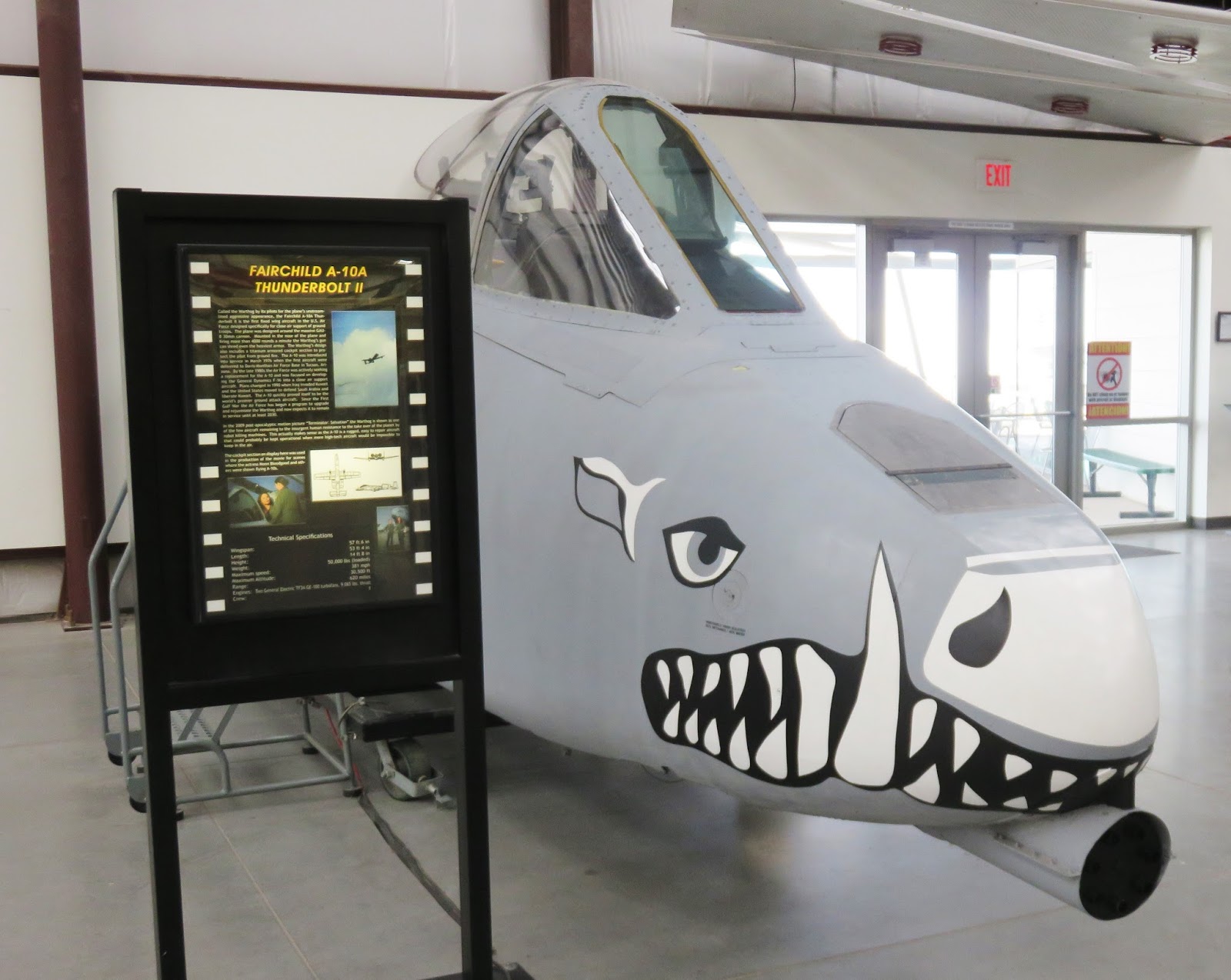
I find myself conflicted about visiting places like the Pima Air and Space Museum because I assume the emphasis of the exhibits will be all about war. I don’t understand war, don’t support war, and don’t like being subjected to war propaganda. I also understand that most people don’t relish the thought of war, and that despite our deepest desire to not see any countries in conflict, the possibility will always exist that at the very least we may have to defend lives on our own turf. (I try to keep this thought first and foremost when walking through museums of this type.) And while the Pima Air and Space Museum did have its share of war related and military machinery, it also had many other displays that I found quite fascinating.
There was
the airplane once recognized as the world’s smallest aircraft, known as The
Bumblebee; mechanical displays of intricate engine design; home-built airplanes
made from “kits”; space travel; aircraft depicted in the movies; a huge exhibit
devoted to Women in Flight; and brightly painted planes of all imaginable
shapes and sizes.
There
were many examples of “nose art”, paintings on the fuselage of airplanes during
World War II, a form of aircraft graffiti. At first I was slightly
uncomfortable with what seemed to me the trivialization of something that
should be somber and entered into regretfully. But after reading some of the
history of this custom I had a greater understanding of how this practice
provided an outlet for military personnel to express individuality, evoke
memories of home and peacetime life, and as a kind of psychological protection
against the stresses of war and the probability of death.
Another
kind of graffiti was also on display in the Round
Trip: Art From The Boneyard Project, which resurrects disused airplanes
from America’s military history and puts them into the hands of contemporary
graffiti and street artists from around the world. Here, entire airplanes were
painted with colorful and imaginative scenes by thirty different artists.
We
concluded our visit with the hour long bus tour of The Boneyard, where an
on-board docent narrated our drive through more than 4000 aircraft from the Air
Force, Navy-Marine Corps, Army, Coast Guard, and NASA. These craft, resting on
over 80-acres, are in varying degrees of storage, regeneration, or preparing to
be recycled.