Sunday, April 30, 2017

San Diego, California (April 2017)

San Diego is one of our favorite California cities, and whether we stay a few days, a couple of weeks, or a couple of months, we always thoroughly enjoy our visit. The beautiful ocean beaches, abundant hiking in and around the city, bike trails galore, and challenging golf courses, there simply aren’t enough days in the week to take full advantage of all the outdoor living San Diego has to offer. But we tried! This visit was for one month only, but we squeezed in as much activity as we could, including visits with my sister who is lucky enough to live here.

The pictures below are a montage of our many outings, in no particular order. They include bike rides on the Bayshore Bikeway and around Mission Bay itself; hikes at Torrey Pines State Park, Cowles Mountain, Stonewall Peak, on the beach, and around Lake Murray; a snap or two from the pretty Mission Bay Golf Course; our visit to the Mission Basilica San Diego de Alcala; and a trip to Historic Old Town San Diego. Along the way we were treated to the massive spring blooms and a variety of birds (and when they cooperated with us, we got pictures of them as well).


We’re wrapping up our time here for this year, but already look forward to our next visit! 


Wednesday, April 26, 2017

Angels Stadium of Anaheim (Anaheim, California)

California has five Major League Baseball teams (San Francisco Giants, Oakland Athletics, Los Angeles Dodgers, Los Angeles Angels of Anaheim, and San Diego Padres), each with their own stadiums in their respective cities. On Sunday, April 23, 2017 we attended a game at the Angels Stadium of Anaheim (Angels versus Toronto Blue Jays), marking the 4th stadium we’ve visited in California, and the 26th of the 30 stadiums nationwide.

Originally known as Anaheim Stadium, and later Edison International Field of Anaheim, Angels Stadium is one of only ten stadiums left without a corporate name, something I really appreciate. Since its opening in 1966, it has been the home ballpark for the Angels, and also to the Los Angeles Rams football team (1980 – 1994). The stadium is often referred to by its unofficial nickname The Big A. It is the fourth-oldest active Major League Baseball stadium, behind Fenway Park, Wrigley Field, and Dodger Stadium.

The Angels lost to Toronto when we were there, in an 8th inning turn around. The Angels were leading 1-0 up until then, when Toronto woke up and scored 4 runs in the 8th and 2 runs in the 9th. The Angels scored one more run in the bottom of the 9th, for a final score of Angels 2, Blue Jays 6.

Some interesting facts about the Stadium include:

Seating Capacity: 45,050

Northridge Earthquake Damage: January 17, 1994 Northridge earthquake caused the Sony Jumbotron to collapse onto the upper deck seats beneath it. No injuries were caused, as the stadium was unoccupied when the earthquake occurred in the predawn hours of a national holiday (Martin Luther King, Jr. Day). The damaged section was deconstructed and rebuilt with a new scoreboard structure and Jumbotron, eliminating the A-frame spire that evoked the Big A.

Light Up The Halo! : Located near the eastern boundary of the parking lot is the landmark "Big A" sign and electronic marquee, which originally served as the scoreboard support. The halo located near the top of the 230' tall, 210-ton sign is illuminated following games in which the Angels win (both at home and on the road), which gives rise to the fan expression, "Light up the Halo!"

Motion Picture Set:  Several major motion pictures have been shot at Angel Stadium. The final sequence of The Naked Gun: From the Files of Police Squad! (1988) features an electronically manipulated Reggie Jackson trying to shoot Queen Elizabeth II; the Disney remake of Angels in the Outfield (1994) prominently uses the ballpark.


UC Irvine Commencement Ceremony:   In 2014, Barack Obama spoke at the commencement ceremony for the University of California, Irvine, which was held at the stadium to accommodate capacity and security concerns.


Wednesday, April 5, 2017

Roads Go Ever On


I was 15 years old when first introduced to the irresistible fantasy world depicted in the writings of J.R.R. Tolkien. My younger sister was actually lucky enough to have a teacher read The Hobbit aloud to her 3rd grade class, and that may have been my first exposure to his works. Soon enough I was reading The Hobbit for myself, followed by The Lord of The Rings trilogy, and over the years I found myself drawn to the stories again and again. At different points in my life I would pick the books up and reread them, each time bonding with the characters a little bit more, gaining new insights into the magic of Middle Earth, the trying to grasp the underlying meaning in the epic battles of Good versus Evil. One of my dreams came true when Peter Jackson turned the trilogy into full length films, with every detail so perfect, as I saw it in my own imagination.

Sprinkled throughout the stories are Tolkien’s poetry and prose, much of which, if not common place, is at least recognizable among fans. Those of you who read my blog have no doubt picked up on the Tolkien-ism in my title, “Not All Those Who Wander Are Lost”. I’m certainly not the only one who has gravitated to this sentiment, as I have noticed other traveling folk adopting this as their credo as well.

There was another line from a poem in The Hobbit that kept rattling around my brain when we ended up on the road for an extended period of time, during those times I started to wonder just what it is we were doing…where were we going…where do all these roads go? Initially I couldn’t remember the entire poem, but one line kept repeating itself…the road goes ever on and on, down from the door where it began.  During one particular road trip I shared all this with Dan, and wanted to find the poem in its entirety to better explain what was going through my head. A quick search on the internet revealed that there was the original version from the books, modified versions for the movies, and even songs that had been made from some of the stanzas. As I was relaying all this to Dan, he said he thought the poem would be a great thing to have hanging on a wall somewhere. This gave me the idea to embroider a cross stitch wall-hanging of the words, because once I read the entire poem, the message just resonated with me even more.

The version I ended up stitching is an amalgam of the original poem that began in The Hobbit, was continued and modified in The Trilogy, and was sung in bits and pieces in the movies. These words so perfectly express my feelings of our Life on The Road, and this will hang on the wall of our house from now on – wherever home may be! 

Monday, April 3, 2017

Kitt Peak National Observatory

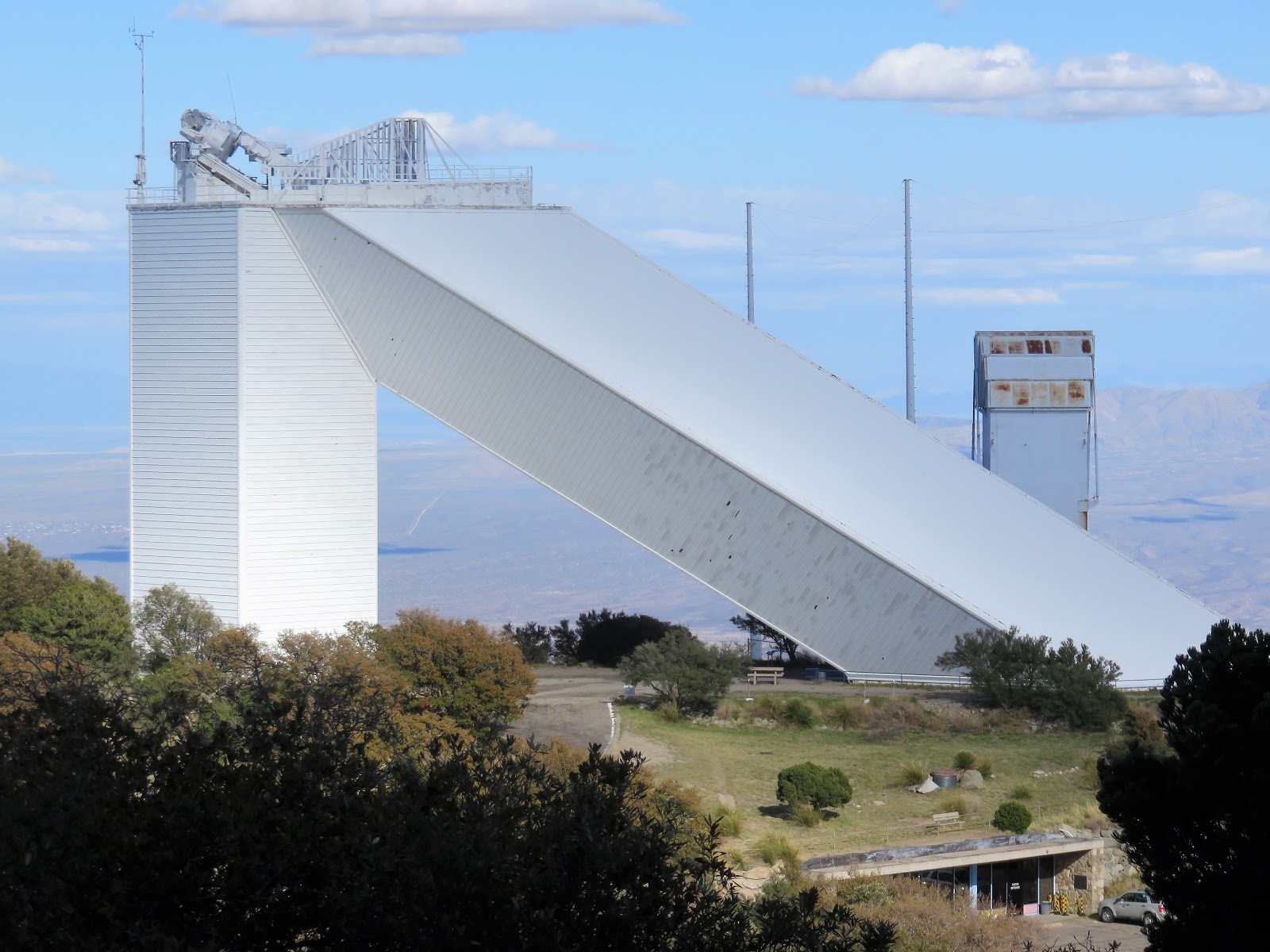
Fifty-six miles southwest of Tucson, and in the midst of the Tohono O’odham Nation, the Kitt Peak National Observatory is nestled in 200-acres of rolling hills at an elevation of approximately 7000 feet. Part of the National Optical Astronomy Observatory (NOAO), this facility supports the most diverse collection of astronomical observatories on Earth for nighttime optical and infrared astronomy and daytime study of the Sun. The Observatory offers both daytime tours and nighttime observation programs, and our goal was to attend one of the nighttime observation programs during a new moon and non-cloudy night. It took a couple of tries, but finally we were able to schedule our tour for March 27, a clear night with no moon for optimum viewing.

Kitt Peak is home to 25 optical and 2 radio telescopes and offers professional and hobby astronomers some of the finest observing to be found in the world. Visitors can choose from three guided tours during the daylight hours, or take self-guided tours of the 4-meter, 2.1 meter, and McMath-Pierce Solare telescopes. There are also three separate Night Program options, including an overnight option for the more serious astronomy buffs. We arrived early in the day so we could tour the Visitor’s Center, explore the stationary exhibits, and get a feel for the surroundings. Afterwards we participated in the 4-hour nighttime program that started with a dramatic sunrise, followed with an introduction to using star charts, binoculars, and most dramatically, research-class telescopes to observe a variety of astronomical objects in the night sky.


Our guides were very knowledgeable and friendly, and treated us to a wonderful overview to stargazing. The most exciting part for me was our telescope viewing, where we were able to view a double star system in the Big Dipper; a dying star with fuzzy edges and a bright spot exploding in the middle; a star cluster aptly called Salt and Pepper; a distant cigar shaped galaxy called M-82 (I couldn’t believe I was looking at a galaxy nearly 12 million light years away!); and the grand finale, Jupiter - as sharp as a photograph with the bands clearly visible, and four of its moons shining like pinpoint stars. I was amazed, impressed, and humbled to have the opportunity to glimpse a wee speck of what exists in our glorious Universe.