Showing posts with label Eleanor Roosevelt. Show all posts

Monday, April 8, 2019

Top Cottage and Val-Kill Cottage Roosevelt Retreats

Besides Springwood, the family home to FDR from birth until death, both Franklin and Eleanor Roosevelt had their own separate retreats on the estate where they could each get away to pursue their own interests. FDR’s place was called Top Cottage, and Eleanor’s was Val-Kill. We were able to walk from one to the other on the day we toured them both, where we learned a great deal about their various pursuits.

Early in his presidency, FDR imagined a refuge from the demands of the office, and when it became increasingly difficult for him to find solitude at Springwood, he began plans for Top Cottage. A place, in his words, where he could go to relax and “escape the mob”. Construction began in 1938 and FDR expected to spend time at Top Cottage during his retirement sorting his papers and collections, writing his memoirs, and maybe even take a stab at fictional detective stories. As it happened, he remained in office and used the cottage for many daytime visits between 1939 and his death in the Spring of 1945.

Eleanor Roosevelt’s legacy in human rights and world peace emerged from Val-Kill, a simple place, and her home from 1945 until her death in 1962. She described Val-Kill as the place “where I used to find myself and grow”. This was Eleanor’s place to gather family, friends, and associates, picnic, walk in the woods, ride horses, and swim. Val-Kill was both a retreat and a center of advocacy and activism. Here she also tested progressive ideas, discussed controversial issues, and inspired students and civil rights and labor leaders to debate and organize.

Here are some pictures of their respective retreats and the surrounding area


Saturday, March 30, 2019

Franklin D. Roosevelt Presidential Library

In late August 2018 we spent a couple of days touring the Franklin D. Roosevelt Presidential Library, the FDR childhood home, and both Eleanor and Franklin’s personal cottages. All of these structures are located on the grounds of the Roosevelt family estate of Springwood, in Hyde Park, New York.

Our first stop was to the presidential library. This is the first of the thirteen presidential libraries under the auspices of the National Archives and Records Administration and was built under the President’s personal direction in 1939-1940.  Prior to Roosevelt's Presidency, the final disposition of Presidential papers was left to chance. Although a valued part of the nation's heritage, the papers of chief executives were private property which they took with them upon leaving office. Some were sold or destroyed and thus either scattered or lost to the nation forever. Others remained with families, but inaccessible to scholars for long periods of time. The fortunate collections found their way into the Library of Congress and private repositories. Roosevelt was the first to make his papers available to the public by donating them to the government. In erecting his library, Roosevelt created an institution to preserve intact all his papers.

There are countless volumes written about FDR, Eleanor, the years they were in office, their personal lives, the depression, the war. I personally found Eleanor as interesting and influential, if not more so, at times, than Franklin. Even though both of them came from immense family wealth, the importance and well-being of those less fortunate was always a priority for them. Further exploration for those interested is there at our (internet) fingertips.

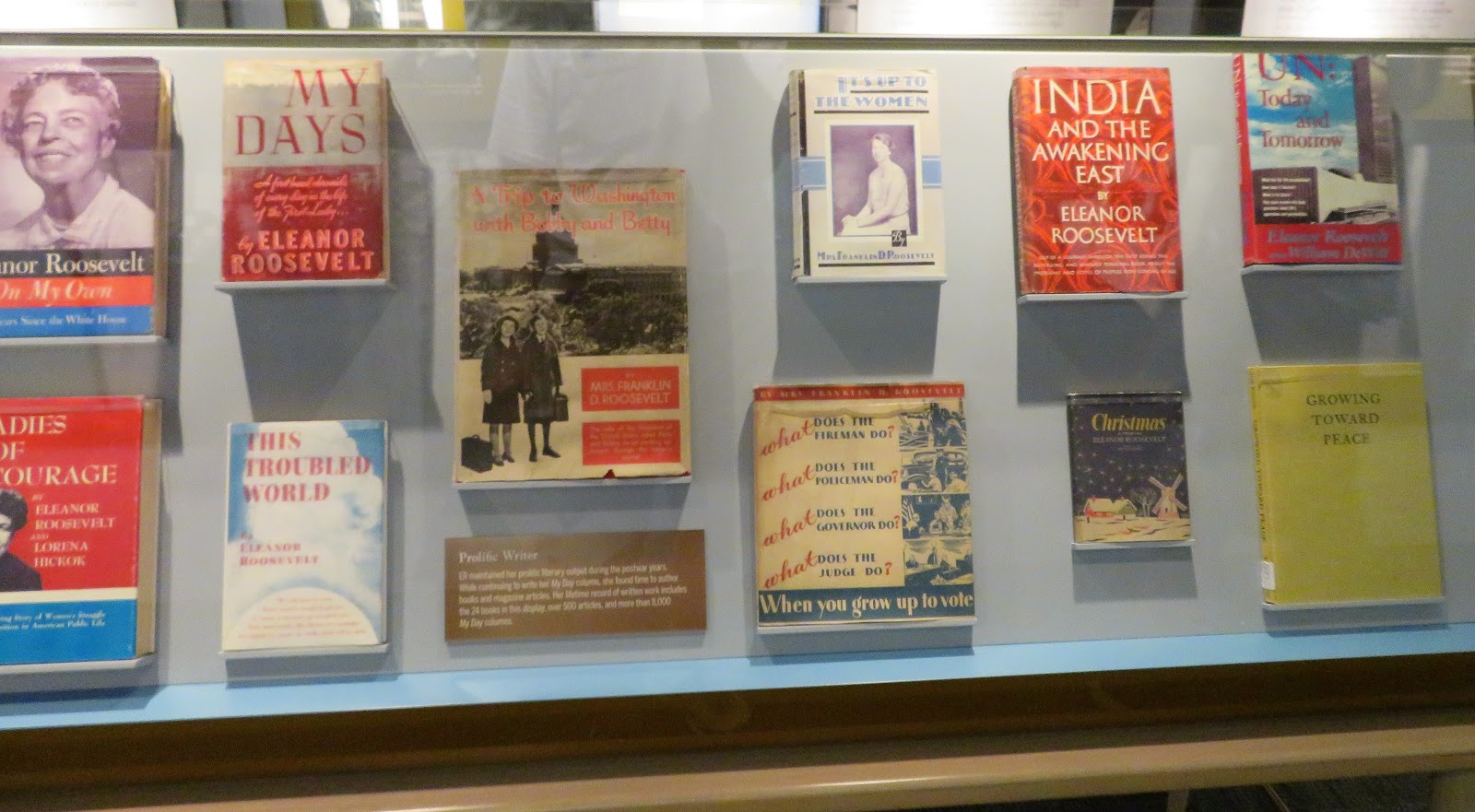
For this post, I will just mention these ten major accomplishments, along with pictures we took at the presidential library.

  1. FDR served as governor of New York from 1929 to 1932.
  2. He is the longest serving president in the history of the United States.
  3. He arrested financial panic through the Emergency Banking Act.
  4. The FDIC was established through the 1933 Banking Act.
  5. Roosevelt set up many important institutions as part of his first New Deal, included the CCC, PWA, TVA and FERA.
  6. The US Social Security System was created during his presidency.
  7. He established a national minimum wage through the Fair Labor Standards Act.
  8. He took the first federal action to prohibit employment discrimination.
  9. Along with Churchill and Stalin, FDR led the allied coalition to victory in World War II.
  10.  He Played a major role in the creation of the United Nations.