Showing posts with label State Capitals. Show all posts

Thursday, May 7, 2015

Jackson, Mississippi


In late August 2007 Dan and I pulled our trailer out of Sacramento to begin a new phase of our lives, living life on the road. One of our goals was to make it to every State Capitol as we worked our way around the country. We didn't impose any sort of schedule on ourselves to complete this goal, instead just making it a point to work these visits into the mix as we traveled through each of the states. On April 27, 2015 we made it to our 50th and final State Capitol in Jackson, Mississippi. As luck would have it, the entire building was apparently going through a major renovation. Scaffolding completely surrounded the dome outside, construction workers were everywhere, and building projects were underway inside as well, blocking our view of the rotunda. Upon entering the capitol, we noticed the entire place seemed rather quiet, almost deserted. In fact, we seemed to be the only two people in the building. Then we noticed the entire downtown area was rather like a ghost town. Unbeknownst to us, the last Monday in April is a state holiday in Mississippi (Confederate Memorial Day). Due to the holiday, much of the building was closed off, so our final capitol visit, restricted by both construction work and the holiday, was a bit anti-climatic, but one we won't forget.

Some fun facts about Jackson and Mississippi:
  • Jackson is one of only four cities of the world sanctioned by The International Theater-Dance Committee to host the International Ballet Competition. The other three include Moscow, Russia, Varna, Bulgaria and Helsinki, Finland.
  • If Mississippi smells lemony fresh, that’s because Pine Sol was invented in 1929 by Jackson native Harry A. Cole, Sr.
  • Still have your first teddy bear? Thank Theodore Roosevelt. On a hunting expedition in 1902 in Sharkey County, President Roosevelt refused to shoot a captured bear, an act which resulted in the creation of the teddy bear.




Sunday, April 19, 2015

Selma, Alabama: The March to Montgomery


"The right of citizens of the United States to vote shall not be denied or abridged by the United States or by any State on account of race, color, or previous condition of servitude". These are the words of the 15th amendment, ratified on February 3, 1870. Why, then, in 1965 did we have people in power who were allowed to blatantly and violently deny American citizens this right, something that should have been guaranteed by law?

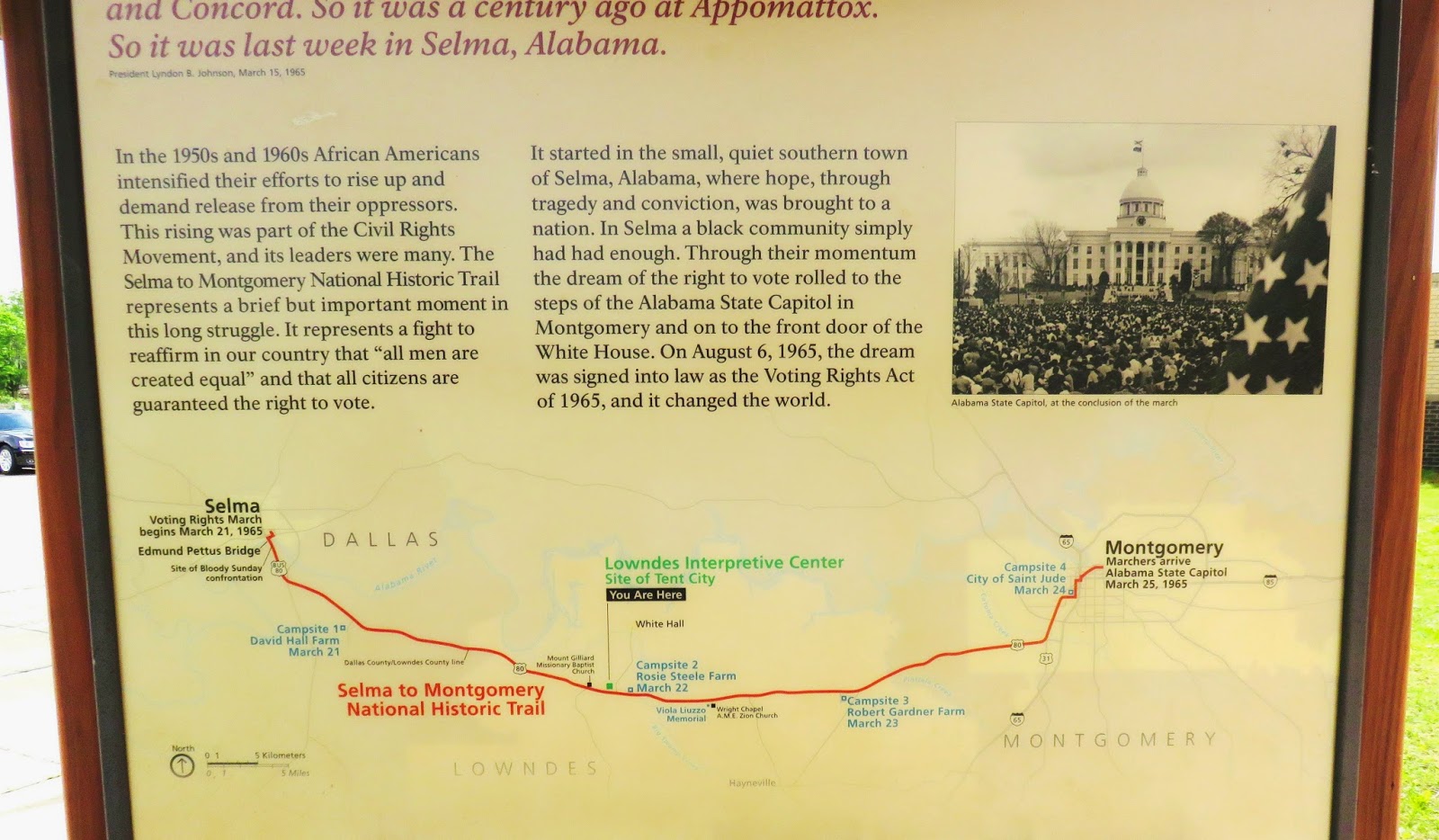
2015 marks the 50-year anniversary of the pivotal 1965 Selma to Montgomery Voter's Rights March, an event that culminated the journey of 100 years by African Americans to gain one of the most fundamental of American freedoms, the right to vote. The walk was led by Martin Luther King, Jr., and started out with 4000 marchers on March 21st. By March 25th when the walk ended at the Capitol steps in Montgomery, the numbers had swelled to 25,000. Having just seen the movie Selma, and being in Montgomery for our capitol tour, we set aside a day to make the drive between the two cities along the actual route the marchers took.

The 50-mile drive was broken up with milestones from the march including the four campsites the marchers stayed along the way and the Lowndes County interpretive center which depicted the events leading up the march, the march itself, and the aftermath. It was difficult walking through this museum, reading about the violence and oppression, seeing images from Bloody Sunday, and hearing the voices of the brave citizens who put their lives on the line to fight for what should have already been rightfully theirs. There were far too many victims of unprovoked violence, far too many innocent lives lost.

In Selma, a small town of just 20,000, we found remnants of the just concluded 50-year Jubilee celebrating these historic events. We parked the truck and took a walking tour of the town, following the path that traced the series of events leading up to the march. We walked across the Edmund Pettus Bridge, trying to imagine what it would have been like to be part of the original group taking those first steps forward.

I was only 9-years old when all this was happening. My understanding of this era is seen through an abstracted rear view mirror, my lessons coming from books, school, and even movies and television. Now, finally having a chance to get a more hands on discovery through actual visitations to Selma and Montgomery, my awareness of the turbulent and dangerous events of the Civil Rights Movement has deepened. Although most of us take our voting rights for granted, not so long ago people were prepared to die to ensure this civil liberty.  I want to believe we've come a long way in 50 years, and in many ways we have. I like to think the quote "Rosa sat so Martin could walk, Martin walked so Obama could run, Obama ran so our children could fly" represents a continuum of progress we still need to see continue in today's world.


Monday, April 13, 2015

Montgomery, Alabama

As winter wrapped up for yet another season, so did this year's travel hiatus. After staying in one place for four months, moving back into travel mode can take some getting used to. With each week that goes by, you get a little more spread out, and a little more stationary. But soon enough we shifted gears, and since the grass was literally growing under our feet (or in this case, under the tires of our 5th wheel), it was more than time to move on. April found us back on the road and headed towards Montgomery, Alabama, one of the last two state capitols on our list.

Having just seen the movie Selma, our visit to this particular State Capitol was especially timely and significant. This year marks the 50th anniversary of the 54-mile Selma to Montgomery March for Voter's Rights, which terminated on the Capitol steps March 25, 1965. The Alabama Civil Rights Trail weaves throughout the Capitol neighborhood and encompasses the Dexter Avenue King Memorial Baptist Church and the Civil Rights Memorial, which we explored before our docent led tour of the Capitol itself.

And while we usually prefer to tour state capitols without a guide, this time we didn't mind. We were lucky enough to have Aroine Irby for our docent, who was just 19-years old when he participated in the march from Selma to Montgomery. In 1965, Aroine was not permitted through the capitol doors because of the color of his skin. Retired from the Air Force, today he leads tours of the State Capitol, is a state historian, and a voting member for the Bureau of Tourism and Travel. So much has changed in 50 years! Aroine's entertaining way of imparting his knowledge of the Capitol artifacts, history of Alabama, and the Civil Right's movement in particular, made for a very lively and moving tour.