Tuesday, September 13, 2016

Great American Ballpark (Cincinnati, Ohio)

 If you have followed my blog from the beginning (August 2007), or even just read the introductory remarks on this blog’s homepage, you are aware that one of our goals as we travel the country is to get to all 30 Major League Baseball (MLB) parks. We began this summer with twenty checked off the list, and figured since we were on the east side of the country already, we may as well pick up the Midwestern teams we hadn’t got to yet. So began our 2016 continuation of the Great MLB Park Tour, with our first stop in Cincinnati, Ohio to watch the Cincinnati Reds versus the Texas Rangers on 8/24/2016. The Reds have been around a long time, and have an interesting history.

The original team was called the Cincinnati Red Stockings, founded in 1866, and was baseball’s first fully professional team. There has been a litany of name changes, city changes, star players, and championships since then, way too much to document here, but easy enough to search out on the internet for those who are interested. I thought it would more fun to highlight a couple of the “fun facts” about the team instead!

  •        The highest recorded attendance in a season was 2,629,708 in 1976, which happened to be the year they won their second consecutive World Series title.
  •        The Cincinnati Reds were expelled from the National League in 1880 for continuing to rent out the ballpark on Sundays and not ceasing to sell beer during games.
  •        There are some hardcore Reds fans that believe Opening Day should be named a Cincinnati holiday. For decades, the first pitch of every major league season officially took place in Cincinnati, and the Reds remain the only major league team to always open the season with a home game.

 Attendance during the game we attended was 16,001 (capacity is 42,319), and despite “root, root, rooting” for the Home Team, Texas won, 6-5. 


Monday, September 12, 2016

Hiking the Adirondacks (Pharaoh Lake Wilderness)

Spoiler Alert: Adirondack is more than just a style of chair!

Among the many joys of traveling the country is finding new places to hike, and when time and terrain allow, we love to indulge ourselves in this activity, one of our favorite pastimes. We got such an opportunity while staying in Ticonderoga, located in Upstate New York, inside the confines of The Adirondack Park. With the boundary set by the Adirondack Mountains, the park includes New York’s Forest Preserve, and unlike most preserves, about 52% of the land is privately owned. The area contains 102 towns and villages, with a year-round population of 132,000 and an additional 200,000 seasonal residents. The park encompasses 6.1 million acres with more than 10,000 lakes, 30,000 miles of rivers and streams, and a wide variety of habitats including wetlands and old-growth forests. We spent just one day hiking a very small part of this vast expanse, exploring a trail in the Pharaoh Lake Wilderness on the Putnam Pond Trail. A mostly gentle walk through the woods, we passed ponds, thick forests, interesting plant life, and met a few weekend pack-backers along the way. As so often happens, we weren’t here nearly long enough to thoroughly explore the area – so many trails, so little time! But we are always grateful for even a small sampling of the beauty of places such as this.

Now here’s the rest of the story on the Adirondack chair: Around 1903 Thomas Lee, searching for comfortable outdoor furniture for his country cottage in Westport, New York, near the Adirondack Mountains, came up with the prototype of this style of chair. According to legend, Lee created several iterations of his chairs made out of just eleven pieces of knot-free wood, all from the same tree. His family tested each chair, and ultimately decided upon the gentle recline and wide armrests of what we now know as the Adirondack chair. And as they say…the rest is history! 


Thursday, September 8, 2016

Natural Stone Bridge and Caves (Adirondacks)

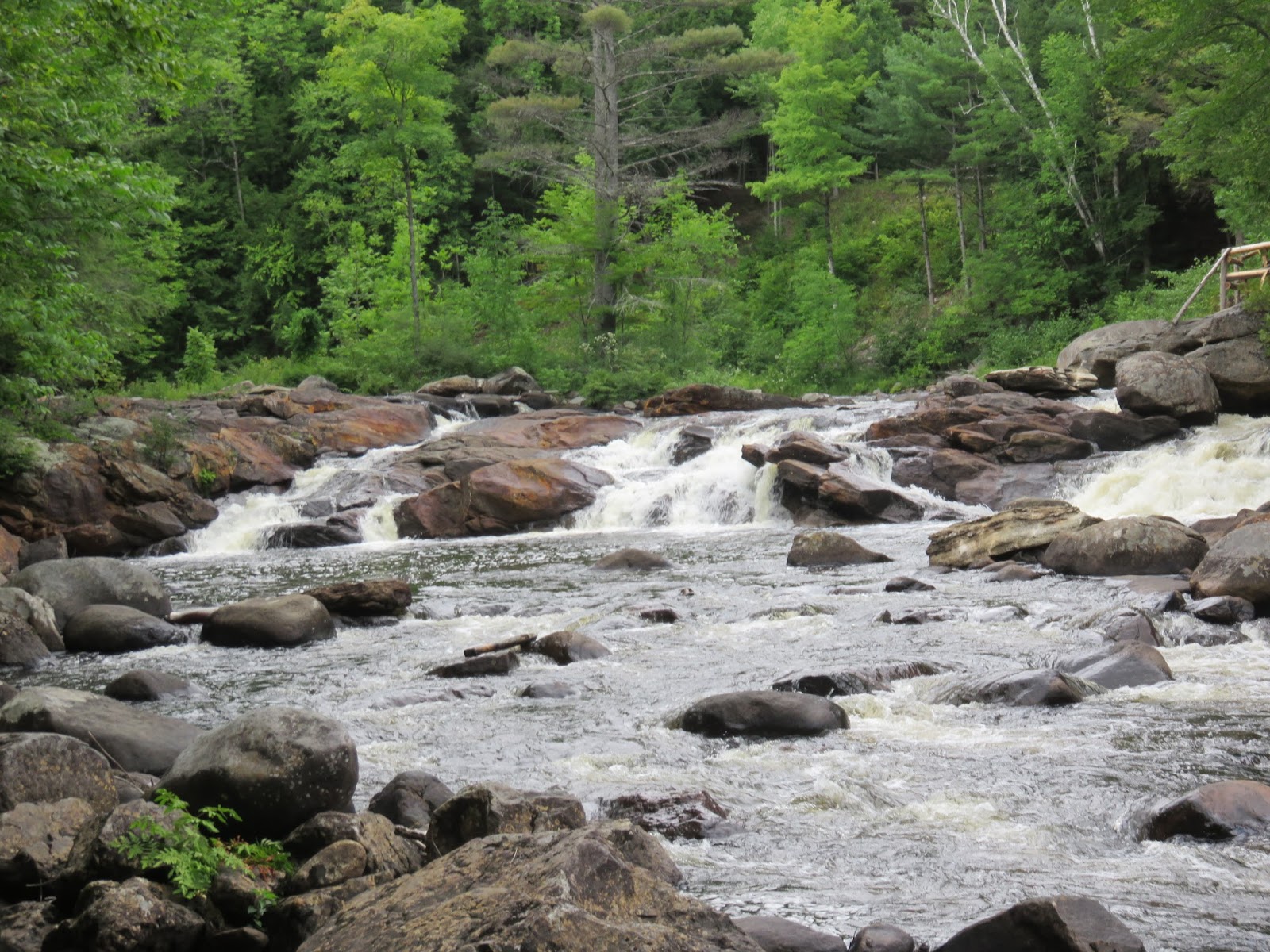
While in the Adirondacks, we took a drive to the nearby small town of Pottersville to visit Natural Stone Bridge and Caves, home to the largest marble cave entrance in the eastern United States. During the latest ice age, an unusual East/West fault exposed this ancient rock to ferocious waters from retreating glaciers. Recent mapping and surveying by the National Speleological Society determined that the resulting Stone Bridge appears to be the largest natural marble cave entrance in the eastern United States. It measures up to 180' wide and 62' high. A privately owned attraction for the last five decades, visitors can hike along a self-guided trail that winds around waterfalls, potholes, and deep pools. Trout Brook emerges into a gorge through several caves, and strategically placed rainbow lights set up along the way create colorful special effects inside the shadowy caverns. Sparkling amethyst cathedrals, Mexican Geodes, Large Quartz Crystals, and hundreds of other rock and mineral specimens are available to view or to purchase for those who want to bring home a keepsake.