Showing posts with label Virginia. Show all posts

Thursday, April 25, 2019

Luray Caverns

One of the highlights of our visit to Luray was touring the Luray Caverns. The cave was discovered in 1878 by five local men and has been open to the public since 1922. The cavern system is the largest in the Eastern United States and is adorned with looming colorful columns, petrified mud flows, stalactites, stalagmites, and mirrored pools.

There is a spring of water called Dream Lake that has an almost mirror-like appearance, where stalactites reflected in the water appear to be stalagmites. This illusion is often so convincing that people are unable to see the actual bottom, even though the deepest point in the water is only around 20 inches deep. The lake is connected to a spring that continues deeper into the caverns.

The Wishing Well is a green pond with coins three feet deep at the bottom, and like Dream Lake, the well also gives an illusion, but in reverse. The pond looks three or four feet deep, but is actually six to seven feet deep.

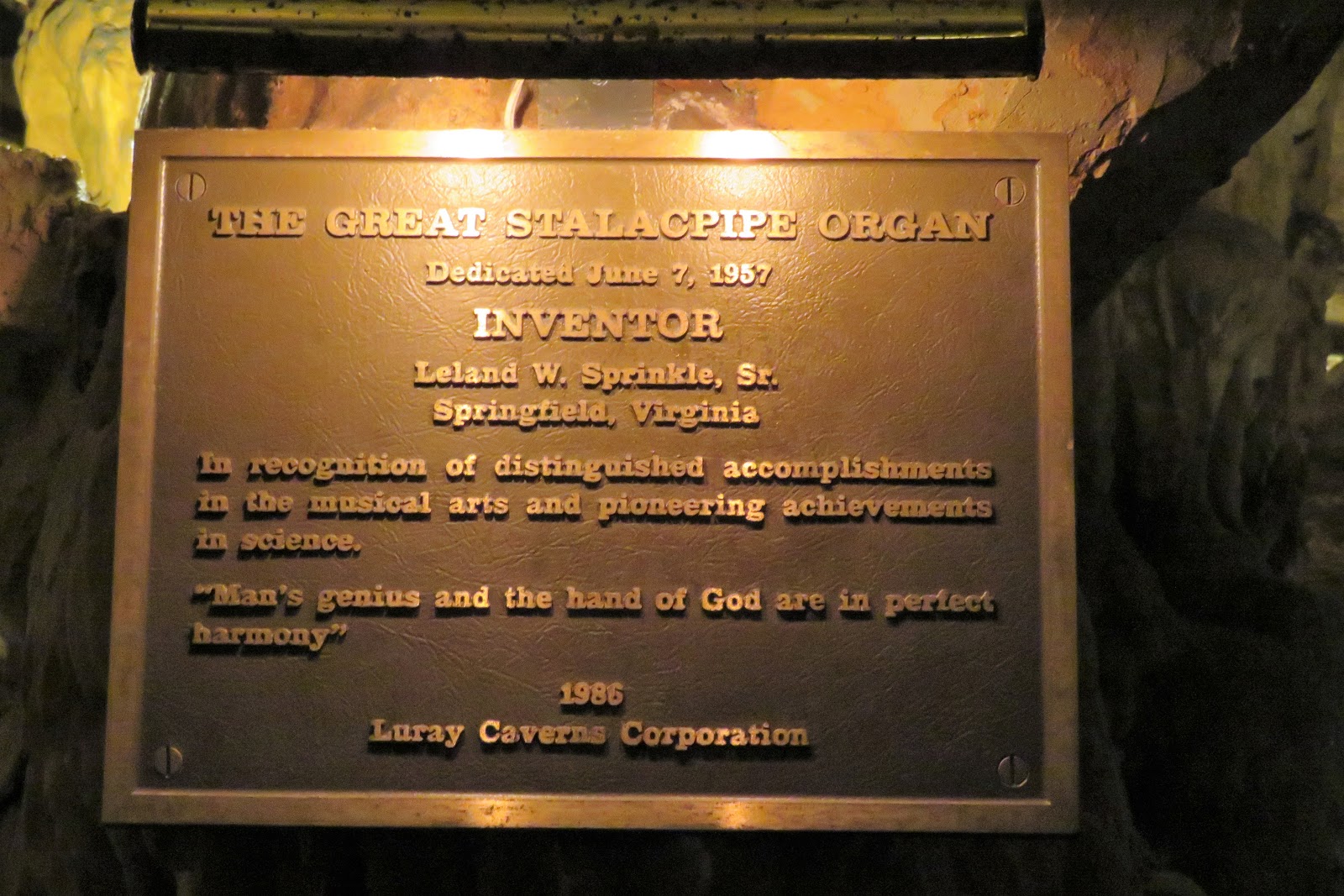
Located deep in the caverns is the Great Stalacpipe Organ, an electrically actuated lithophone made from solenoid fired strikers that tap stalactites of various sizes to produce tones similar to those of xylophones, tuning forks, or bells. This one-of-a-kind instrument was invented and built in 1954 by Leland W. Sprinkle, a mathematician and electronic scientist at the Pentagon. He began his monumental project by searching the vast chambers of the caverns and selecting stalactites to precisely match a musical scale. It took him over three years to complete it. 


There isn’t much more I can say about these caverns that couldn’t be better experienced by being there, or at least looking at just a few of the dozens of pictures we took while we were there. 


Shenandoah National Park (Virginia)

Shenandoah National Park extends along Virginia’s Blue Ridge Mountains, with a vast network of trails, including a section of the long-distance Appalachian Trail. Mostly forested, the park features wetlands, waterfalls, and rocky peaks, and visitors are treated to stunning view of the Shenandoah Valley from points along the 105-mile long Skyline Drive.

The construction of this park was not without controversy, though. Much of the land targeted for inclusion in the National Park had been held as private property for over a century. More than 5,000 parcels were inhabited by tenant farmers or squatters, and many local families had lived in the area for generations. Many did not want to sell their land, and some refused to sell at any price. These residents were promised that if they sold their land to the state, they could still live on their homesteads for the rest of their lives.

However, when many families continued to refuse to sell their land, proponents changed tactics. Miriam Sizer, a social worker, was hired to teach at a summer school in the community and asked to write a report about the living conditions. Although later discredited, her report depicted the local population as very poor and inbred, and was soon used to support forcible evictions and burning of former cabins so residents would not sneak back.

Also troubling was the racial segregation of park visitors. In the early 1930’s, racial segregation was the order of the day, and Virginia initially attempted to ban African Americans entirely. Eventually the state settled for enforcing segregation laws in the park’s facilities.

From the 1960’s onward, park operations broadened from nature-focused to include social history. Some displaced residents and their descendants created the Children of the Shenandoah to lobby for more balanced presentations. The park hired cultural resource specialists and conducted an archeological inventory of existing structures. Eventually the park’s new focus on cultural resources resulted in the removal of questionable interpretive displays and included hikes and tours explaining the social history of the displaced mountain people.


The turbulent social history of this National Park gave me an even greater appreciation of the land and the people who once inhabited it.