Friday, April 26, 2019

Manchester, Tennessee (South Cumberland State Park & Natural Bridge State Natural Area)

We left Luray, Virginia September 26, 2018 and took two days to travel 520 miles south and west to Manchester, Tennessee. The main reason we chose this particular route, and place to stop, was to attend a concert in the underground Cumberland Caverns on September 30th (more on this in a separate post). Manchester is located halfway between Nashville and Chattanooga, and since 2002 has been the host city for the annual Bonnaroo Music Festival where the city’s population swells from 10,000 to nearly 100,000 for the four day-event. Unfortunately our timing wasn’t right for Bonnaroo, but we were there for a week and much to our delight there was an abundance of hiking opportunities in the area.

Two of the places we hiked are pictured below (additional hikes will be in separate posts).

South Cumberland State Park, 25 miles from our RV park, and located on the Cumberland Plateau, is a newer state park, filled with meadows, waterfalls, beautiful views, and old growth trees. We took the hike to Greeter Falls, which required a long descent on a spiral staircase, and Boardtree Falls, a trail with far fewer hikers, but with falls that were equally as rewarding.


On a separate outing we drove about 30 miles to the Sewanee Natural Bridge, part of the 3-acre Natural Bridge State Natural Area. A 25-feet high natural sandstone arch with a span of 50 feet, Sewanee Natural Bridge is essentially a giant sinkhole partially eroded to form a large stone bridge. 


Thursday, April 25, 2019

Luray Caverns

One of the highlights of our visit to Luray was touring the Luray Caverns. The cave was discovered in 1878 by five local men and has been open to the public since 1922. The cavern system is the largest in the Eastern United States and is adorned with looming colorful columns, petrified mud flows, stalactites, stalagmites, and mirrored pools.

There is a spring of water called Dream Lake that has an almost mirror-like appearance, where stalactites reflected in the water appear to be stalagmites. This illusion is often so convincing that people are unable to see the actual bottom, even though the deepest point in the water is only around 20 inches deep. The lake is connected to a spring that continues deeper into the caverns.

The Wishing Well is a green pond with coins three feet deep at the bottom, and like Dream Lake, the well also gives an illusion, but in reverse. The pond looks three or four feet deep, but is actually six to seven feet deep.

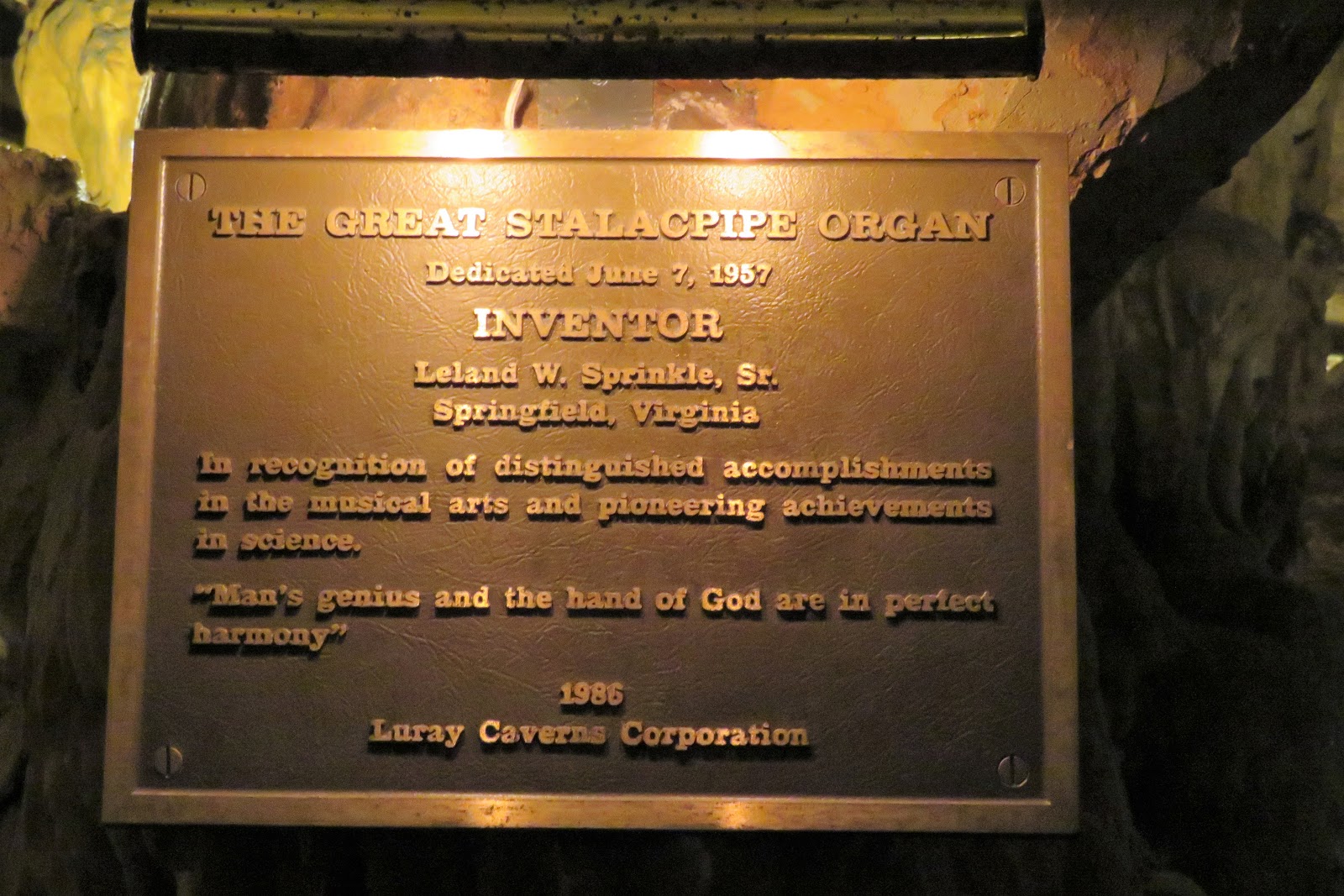
Located deep in the caverns is the Great Stalacpipe Organ, an electrically actuated lithophone made from solenoid fired strikers that tap stalactites of various sizes to produce tones similar to those of xylophones, tuning forks, or bells. This one-of-a-kind instrument was invented and built in 1954 by Leland W. Sprinkle, a mathematician and electronic scientist at the Pentagon. He began his monumental project by searching the vast chambers of the caverns and selecting stalactites to precisely match a musical scale. It took him over three years to complete it. 


There isn’t much more I can say about these caverns that couldn’t be better experienced by being there, or at least looking at just a few of the dozens of pictures we took while we were there.